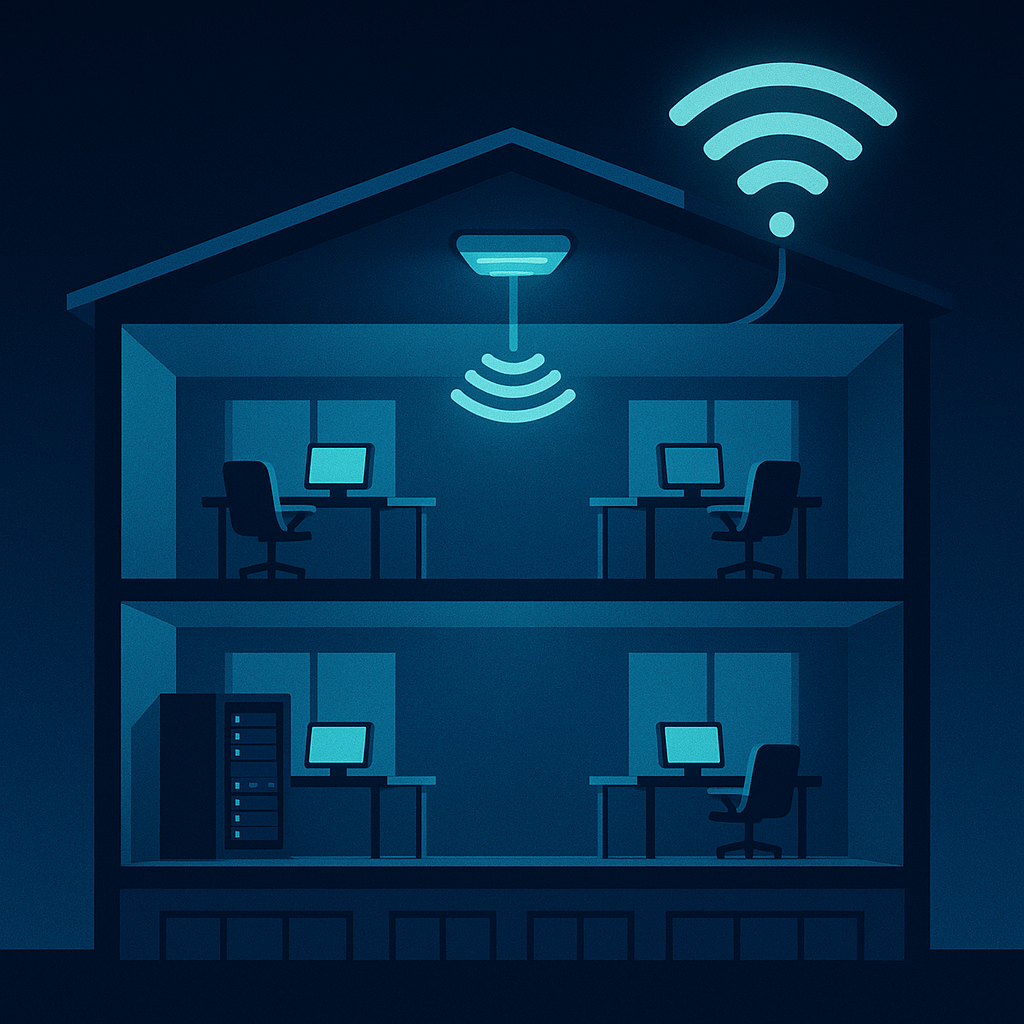
The network left the cable tray. And it never came back. What started as a convenience feature for conference rooms slowly turned into the backbone of modern enterprise IT. Around 2005, wireless LAN stopped being a secondary access layer and became real infrastructure. Laptops replaced stationary desktops, offices lost their fixed ports, work became mobile. Suddenly it no longer mattered where a network socket was located. What mattered was coverage. Mobility became expectation. WLAN was no longer a bonus feature. It became mission-critical.At first, enterprise WLAN was fragile. Unstable roaming, limited throughput, interference, weak encryption, all of it came with the early deployments. Security felt more like hope than control. Still, companies pushed forward because the business value was simply too strong. Employees accepted temporary dropouts as long as they could move freely. This was the real shift. For the first time, the network was no longer tied to the physical workspace. It followed the user.As wireless matured, the entire network architecture began to change. Controller-based designs entered the scene. Intelligence moved into the core. Access Points became field sensors rather than standalone devices. Campus networks suddenly had to be designed not only around switches and VLANs, but around radios, channels, walls, people and movement patterns. Network planning became spatial. The building itself became part of the topology. This was no longer just switching and routing. It was RF engineering blended with classical enterprise design.
Cisco dominated this phase early on, especially after acquiring Airespace and pushing its centralized WLAN platforms into the enterprise. At the same time, new specialists entered the market. Aruba built a strong identity around mobility and security. Ruckus introduced adaptive antenna designs for complex environments. Enterprise WLAN became its own battlefield with its own standards, certifications and tribal knowledge. Wireless was no longer an accessory to the LAN. It was an equal layer.Trust followed stability. As performance increased and security matured with 802.1X, RADIUS, WPA2 Enterprise and later WPA3, companies began to push WLAN into areas once considered untouchable. Production floors. Warehouses. Hospitals. Universities. Logistics centers. VoIP handsets moved off the cable. Scanners roamed through storage aisles. Medical devices started to rely on wireless connectivity. WLAN became operational infrastructure. Outages no longer meant slow internet. They meant stopped processes.With smartphones, everything accelerated. BYOD entered the enterprise by force. Employees brought their personal world into corporate networks. Guests expected connectivity like water and electricity. WLAN became a reputation factor. A poor wireless network suddenly felt like a sign of technological decay. A stable, fast, seamless WLAN represented modernity and efficiency. The network became visible. And emotionally noticeable.
With WiFi 5 and later WiFi 6 and 6E, wireless finally became powerful enough to carry real-time business traffic at scale. Unified Communications, video meetings, collaborative cloud platforms, all moved freely through the air. The difference between wired and wireless became irrelevant for most users. For many, the cable simply vanished from reality. The network became invisible infrastructure.At the same time, dependency grew. When WLAN fails today, entire organizations stumble. The wireless layer is no longer access. It is the nervous system. Every workflow touches it. Every device depends on it. Even the boundaries between campus, branch networks, home offices and cloud platforms have dissolved. WLAN is often the first link in a long digital chain that reaches far beyond the building.Today, enterprise WLAN is embedded into far larger control systems. SDN, cloud-managed platforms, SASE, telemetry, AI-based optimization. Access Points constantly stream data. Channels adapt in real time. Failures are predicted before users notice them. The air itself becomes programmable. Yet the core need remains untouched. People want to move. They want to work anywhere. They want the network to simply exist. Stable. Invisible. Reliable.
What began as a wireless extension for meeting rooms transformed into the foundation of digital working culture. Corporate networks are no longer tied to walls. They exist wherever people create value. And that is exactly where wireless gained its real power.