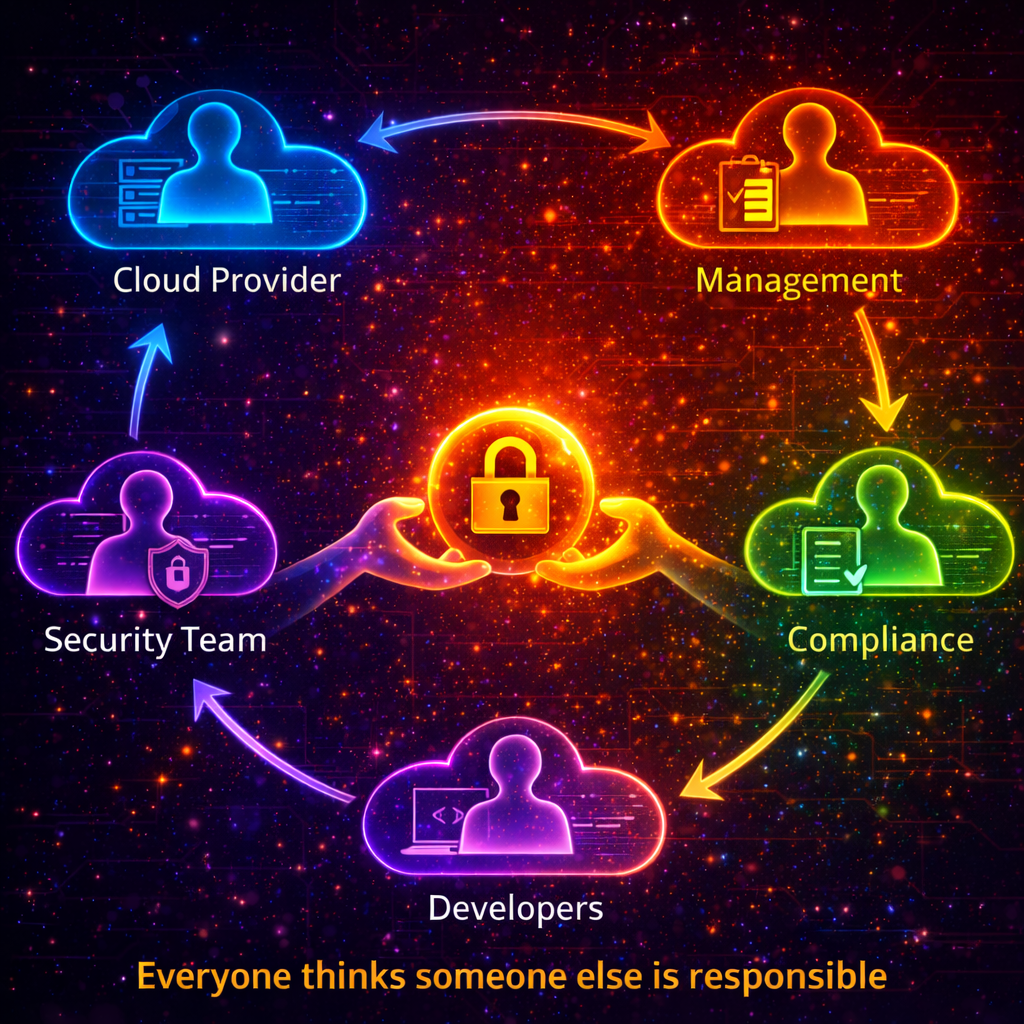
The idea of shared responsibility is one of the most repeated, most referenced and least understood concepts in cloud security. It is printed in every cloud provider’s documentation, shown in almost every architecture slide and referenced in almost every audit, and yet in practice it is one of the main reasons why security failures happen. Shared responsibility sounds reasonable. Providers secure the infrastructure, customers secure what they put on top, platforms provide the tools, organizations use them responsibly, everyone has a role and everyone does their part. In reality, shared responsibility often becomes shared confusion, not because people are negligent, but because responsibility in the cloud is fragmented, abstract and distributed across technical, organizational and legal boundaries that do not align with how companies actually work. A Chief Technology Officer at a large European manufacturing group described it like this: everyone has a piece of the puzzle, but no one sees the whole picture; the cloud provider secures their layer, the platform team secures theirs, developers secure their code, the security team secures policies, compliance secures documentation and management secures budgets, but nobody owns the system as a system. This is the core of the problem. Shared responsibility assumes that responsibilities are additive. In reality, they are subtractive. What is shared is not ownership, but accountability, and when accountability is shared, it tends to dissolve.
Cloud has fundamentally changed how responsibility is distributed. In traditional IT, responsibility was anchored in physical control. Whoever operated the data center controlled the servers, whoever had access had access, whoever made changes was visible, responsibility followed infrastructure. In the cloud, infrastructure is abstracted away, control is mediated through APIs, permissions, automation and policies, systems are no longer owned in a physical sense but referenced, configured and orchestrated, responsibility no longer follows hardware, it follows abstractions, and abstractions are harder to govern. A Head of Platform at a large IT integrator put it bluntly: in on premise environments, responsibility was enforced by friction. You needed access to the data center, approvals to change firewalls, tickets to deploy servers. In the cloud, responsibility is enforced by discipline, and discipline does not scale automatically. Cloud removes friction, that is its strength, but it also removes natural control points, that is its risk.
Most cloud security incidents are not caused by attackers being particularly sophisticated, they are caused by organizations being structurally misaligned: misconfigured access rights, overly broad permissions, missing environment separation, unmonitored automation, forgotten test systems, exposed APIs, unmanaged secrets and unclear ownership. These are not technical failures, they are governance failures. A CISO from a European financial services company described a typical incident: a development team created a temporary storage bucket for testing and forgot to restrict access, the platform team assumed the security team monitored it, the security team assumed it was covered by policy, compliance assumed it would be caught in the audit, management assumed the provider handled it. Nobody did. Everyone acted rationally within their own frame, the failure happened between the frames.Shared responsibility models are described in layers such as infrastructure, platform, application and data, but organizations do not work in layers, they work in functions, teams, incentives and reporting lines, the conceptual model does not match operational reality. This mismatch creates a dangerous illusion: the illusion that responsibility exists because it is defined, that risk is managed because it is documented, that security is covered because tools are in place. A DevSecOps lead described it like this: we had every tool such as identity management, monitoring, scanning, policies and automation, but nobody felt responsible for asking whether the system as a whole still made sense, everyone optimized their part, no one optimized the whole.
This is why cloud security is not primarily about controls, it is about ownership. Who owns the platform as a business system, who decides what risk is acceptable, who arbitrates conflicts between speed and safety, who has the authority to stop deployments, who is accountable when something goes wrong. These questions are uncomfortable because they are political, not technical, they cut across hierarchies, budgets and power structures, and shared responsibility often becomes a way to avoid them. A senior consultant summarized it: providers use it to shift risk to customers, customers to shift it to integrators, integrators to shift it to documentation, and in the end the organization absorbs the risk without consciously deciding to do so. This is the real danger, not that risks exist, but that they exist implicitly.Cloud does not eliminate risk, it changes its form, it becomes more dynamic, more systemic and more tightly coupled; small configuration decisions can have global impact, local errors become global incidents, temporary experiments become permanent exposures. This means cloud security cannot be treated as a function, it must be treated as a capability, the capability to understand systems as systems, to see dependencies, flows, trust relationships and failure modes, and to integrate technology, organization and regulation into a coherent model of accountability.
This is why the most effective cloud security leaders are not necessarily the most technical ones, but the ones who can translate between worlds, between developers and compliance, engineers and management, speed and responsibility. They replace shared responsibility with explicit responsibility. Who owns identity, who owns data, who owns the platform, who owns risk, not in theory, in practice.
Cloud security is therefore not about creating more rules, but about making responsibility visible, tangible and unavoidable, about designing organizations that can operate in environments where control is distributed, speed is high and failures are systemic. From Darkgate’s perspective, shared responsibility is not a solution, it is a starting point, a starting point to ask better questions, design better structures and accept that in the cloud, security is not something you add, it is something you organize. And that is why cloud security is not fading into the background, but moving into the center of how modern organizations understand control, trust and responsibility in a digital world.