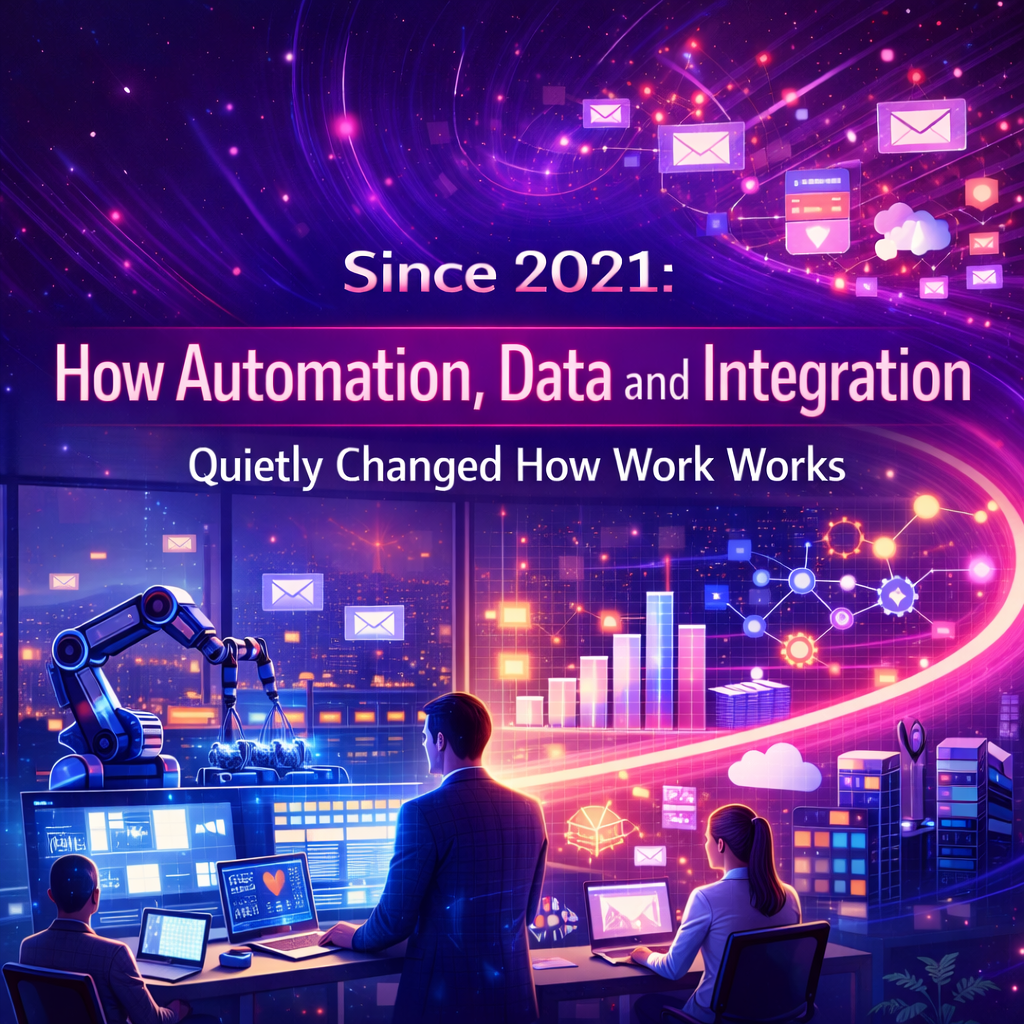
replacements for what already existed, but as additional layers that quietly continued to change how work actually happens. An automation layer emerged that started to connect events directly with actions. Where people had previously forwarded tickets, transferred data or manually triggered approvals, RPA systems, low-code platforms and workflow engines gradually took over these transitions. As a result, work did not only become faster, it became calmer. There were fewer handovers, fewer waiting times and less friction between individual steps. Fewer moments where work was technically “blocked” simply because someone had not yet clicked the next button.
In everyday terms, this meant that work began to flow differently. A customer request no longer waited in a queue until someone manually reassigned it. A document no longer had to be saved in one place, uploaded to another, and then announced by email. A contract no longer waited for someone to notice that it was ready for approval. Events triggered actions automatically. Systems reacted to changes instead of waiting for humans to notice them. The result was not only efficiency, but a new sense of continuity. Work stopped feeling like a sequence of interruptions and started to feel more like a coherent movement.
At the same time, a data layer developed that began to make operational reality visible. Business intelligence systems, analytics platforms and process mining tools no longer showed only outcomes, but patterns. They made visible where work slows down, where it accumulates, where it runs into dead ends or where it becomes unnecessarily complex. They showed not only what happened, but how it happened over time.
For many organizations, this was a subtle but important shift. Problems were no longer discovered only when something failed, when a deadline was missed, or when a customer complained. They became visible earlier, as tendencies, as friction points, as unusual delays or accumulations. Decisions no longer had to be made purely from intuition, but could be based on observation, not in the sense of control, but in the sense of orientation and understanding. Leaders did not gain more power over work, but more insight into it. And that insight changed how conversations were held, how priorities were set, and how responsibility was distributed.
In parallel, an integration layer started to connect what had previously been separate. iPaaS platforms, APIs and event-driven architectures ensured that information no longer remained trapped inside individual systems, but could flow across them. What used to be a constant switching between interfaces, contexts and responsibilities slowly turned into a continuous flow of work. Data moved with the process instead of lagging behind it. Context traveled with tasks instead of being lost at every handover.
In practical terms, this meant that work became less fragmented. People no longer had to constantly reconstruct what something was about, where it came from, or who was responsible. The system carried that context forward. Not perfectly, but enough to reduce cognitive load. Enough to make work feel less like juggling and more like guiding.
Together, these three layers changed the nature of work quietly but profoundly. Systems were no longer only places where work happened, they became participants that shaped how work happened. They did not begin to work instead of people, but with them. They prepared, structured, highlighted and connected. They reduced the number of micro-decisions people had to make, the number of small interruptions that drained attention, the number of invisible gaps between steps.
And this is where the shift toward what is now increasingly understood as Intelligent Work began to take form.
Not as a technological leap, but as a change in work logic. A move away from reactive work toward prepared work. Away from constant searching toward guided orientation. Away from implicit knowledge toward visible relationships. Work did not become easier in the sense of less, but clearer in the sense of more understandable. More legible. More navigable.
This development is not finished. It forms the foundation for what is now emerging. On top of these layers, another layer is beginning to grow, systems that not only connect and display, but recognize patterns, suggest actions and understand context. Not to replace people, but to relieve them. Not to take decisions away, but to prepare them. To make the space of possible actions smaller, clearer and more relevant.
Work therefore does not become faster, it becomes more intelligent. Not louder, but quieter. Not more hectic, but more focused. And perhaps that is the most important aspect of this shift, that progress no longer feels like acceleration, but like clarity.
That work does not feel like it is moving more quickly, but like it is moving with less resistance. That people are not pushed harder, but carried better by the systems around them. And that is what truly changes how work feels.